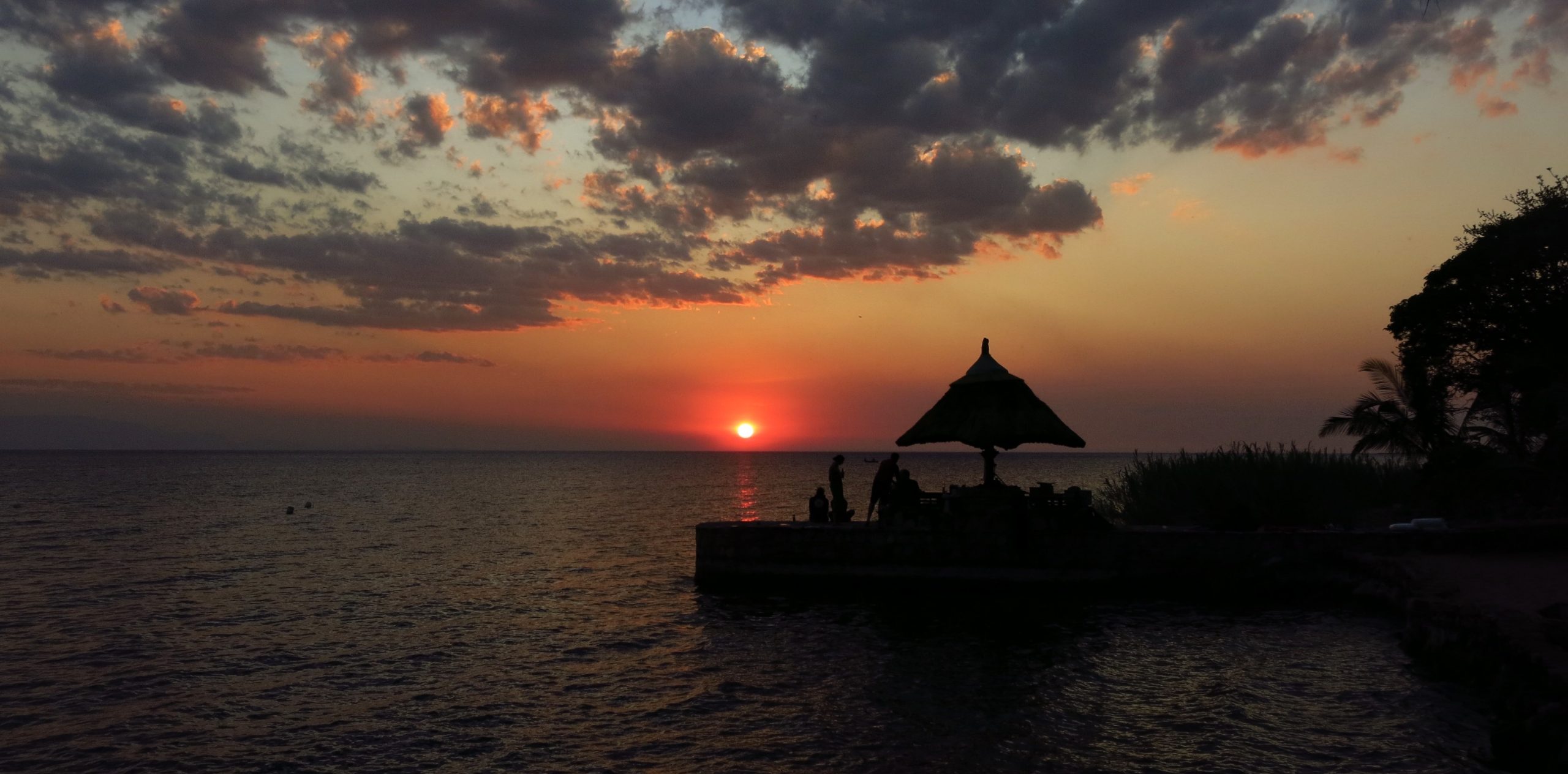
For the first 55 years of my life I had never imagined that I would need to live in a council flat. I had made a life in the heart of Africa on the shores of Lake Tanganyika for over two decades. On a small stretch of the wooded shoreline of this vast freshwater lake, holding around 16% of the worlds total, I had built my home and grown my own business

Time stood still and I have no idea how long I was lying face down in the water. I could feel nothing, my legs didn’t seem to be moving and my arms were not working to pull my face out of the water, I could barely turn my head to gulp some air. I think the blood coming out of my head must have made the other three guys on the jetty realise something was not right, I was not mucking around. After what seemed like an age I felt arms pulling me out of the water and across the small sandy beach onto the flat rocky path in front of the thatched chalets.
My head was spinning and I was close to blacking out. I knew that I was in deep trouble and had to get to a hospital as fast as possible but not quite sure exactly why. There is no 999 emergency service in that part of the world and the nearest local hospital was a sixteen kilometre boat ride to Mpulungu and then forty-five more by a pot-holed tarmac road to Mbala General Hospital. The idea of being hoisted into a helicopter and flown to a hospital was a fleeting fantasy.
Cogs in my brain began to gain a degree of focus, probably driven by the adrenaline of shock. I was supposed to be shipping out a big consignment of live fish to customers in Hong Kong and Germany. Most of the fish had been checked and sorted into the indoor holding tanks ready to pack into plastic bags, filled with oxygen and then put into insulated boxes ready for the 1,100 km drive to Lusaka. This would have to be postponed until I could get back.
As a wooden door was being found to use as a stretcher to load me onto, a group of about ten of my divers had arrived back by boat from a collecting trip, a couple of days late because of bad weather and murky water.
I was giving instructions about what fish to put into which tanks. Certain fish would have to be moved from the inside holding tanks back to outdoor ponds. The rare and expensive Cyphotilapia from Congo needed special attention to make sure they were given the correct feed and to make sure they did not catch whitespot, a disease which would have seen a few thousand Dollars disappear.

It was the end of the month and wages were due to be paid. I had to explain where the safe was hidden in my house and where to find the key, as well as the payslips and other paperwork I had prepared.
There was my 30.06rifle and 9mm automatic that would have to be kept safely as well as the ammunition. My camera and lenses, laptop, IPod and other assorted things kept adding to the list of things.
Jose the fuel-smuggling, currency-changing fishing entrepreneur who lived just over the border in Tanzania where I bought our petrol and diesel from was owed money. I used to pay him cash US$ to get the best price and Jose would then save them up to go shopping in Dubai for goods in his thriving little shop. I also needed to change money into Tanzania Shillings and then find a reliable way for it to reach Oscar, my Tanzanian business partner, at another small tourism project further north up the lake near Kasanga.
Even as I was being lifted onto the wooden door stretcher onto the boat I can remember giving out continuous instructions about jobs that needed to get done and what to look out for whilst I was away and until I could get back.
I had this notion in my head that all I needed was an injection of vitamin B12, a good sleep and then, bingo, I would be back on my feet. This was based on a scary hallucinatory incident from a few years before, after I had finished a deep dive whilst on a course of antibiotics. My mind was conjuring up these bizarre links, and I was sure that this accident was somehow similar.
When we arrived at Mbala Hospital it was night. I was moved from the back of the pick-up van into a ward and off my wooden door cum stretcher onto a bed with a hard mattress and rough blanket smelling of Boom washing paste.
I swore at the nurse who could not find a vein in my hand to insert a drip after multiple efforts; she threatened to call the police and have me arrested. After sometime the decision seemed to be that the only thing I needed was some paracetamol.
The Zambian duty doctor advised that they would not be able to do much to help and I would be best to either go to the regional hospital in Kasama some 200 kms away, or be flown out. I spent the night on my phone making calls trying to sort out an emergency flight to get me to Lusaka.
I spent the rest of the time babbling about all the jobs that needed to get done, and all the things to avoid and to watch out for. It was only around mid-afternoon, 24 hours after the accident that I was given a shot of morphine by the paramedic who had arrived on the emergency flight that would get me get me to Lusaka, the capital city.
The last instructions that I probably gave to Warren, who was going to keep the place in one piece was probably something like, “Oh and can you just make sure you de-tick Blackie, (the dog I inherited from a French vet), he will need worming pretty soon”.
That was to be my last direct communication with the lake for a few weeks. When the plane took off the only things I had were my shorts, my underpants, my wristwatch and my mobile phone. I was to lose my shorts at the next stop.
As the length of my absence grew from days to weeks to a month, then two, three and onwards, the more things began to unravel and the business I had spent my time and energy building seemed to be steadily breaking into pieces. Warren had seemingly cracked up after a couple of months with the responsibility and left with no notice, taking Blackie with him to Lusaka. I found out later that the poor dog had died, but never found out how, where and why.


Fred, the ten foot pet crocodile I had fostered from a Danish farmer had supposedly ‘escaped’ his pen at the lake and was killed in the next door village. Lots of the fish I had been breeding and the ones collected for export had died including the rare and expensive Cyphotilapia. One survivor was Percy, the legendary Nile perch, a rare golden colour mutation and the only one in captivity anywhere in the world.
After seventeen months of a hospitalised, bed-bound existence I pushed myself out of the Midlands Centere for Spinal Injury in a wheelchair, weak and pale as a cup of milk.. The council flat that had been found for me in mid Wales was going to be a temporary base whilst I rehabbed before going back to my work, my employees, my friends and my home in Zambia.
It took a few years before the reality seeped in that no matter how much physio I did, I would not walk again. My spinal cord would never send all the millions of messages to the different parts of the body and get it to react and behave the way used to.
This was a mirror of the breakdown of communications to the lake and to my previous life which I could see would be impossible to operate from 6,000 miles away, no matter how hard I tried or wished.
Trying to come to terms with paralysis together with the loss of a way of life built up for over twenty years with no real chance to return to it has been bloody traumatic. Slowly different things have shifted into place over time like moving different pieces of a tricky jigsaw puzzle into place as a picture starts to emerge from all the different colours shapes and sizes. Unlike a jigsaw, life is a dynamic, breathing, moving, ever-changing picture but both can easily be broken into pieces in the blink of an eye.
