
Getting through the winter months has often been a struggle for me. Long dark nights and short grey days with rain throughout have never really appealed . The winter solstice and Yuletide is always a time that signifies moving into longer days but time seems to drag until this becomes a reality. In the garden the signs of spring have been appearing for a few weeks now. First some snowdrops, a few winter aconite, winter iris with crocuses emerging. But one of the biggest lifts I get is from the hellebores.
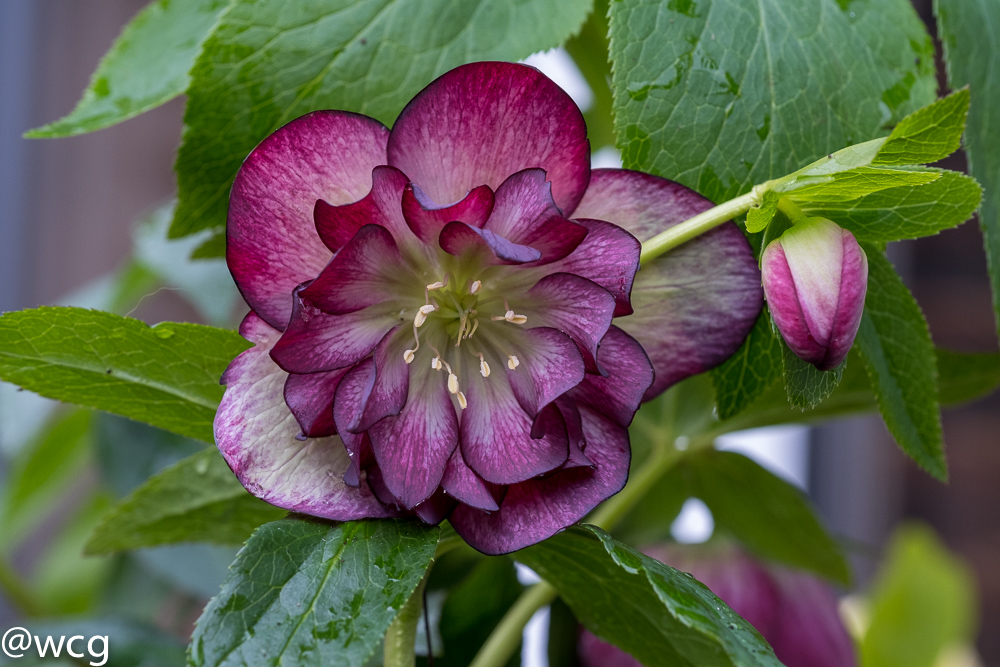
There is something about hellebores which really appeals and I have managed to build up a pretty nice collection over the past few years with close to forty different hybrids. Some are in the garden and some are on a shelf, in pots, outside my front window. When I look at why I like them- aside from appearance alone- a few thought spring up. Plants are like people you can build different relationships for different reasons.
Hellebores are the subject of differing legends:
- In some areas of witchcraft it is believed the plant had ties with summoning demons.
- Heracles killed his children by Megara in a fit of madness that was induced by Hera. This madness was cured by using hellebores.
- In 585 BC it was reported that during the First Sacred War, Greek attackers used hellebore to poison the city’s water supply during the Siege of Kirrha. The residents of the city were so weakened by diarrhea that they were unable to defend against the assault and were all slaughtered. This is one of the earliest recorded uses of chemical warfare. Some historical accounts for this poisonous plan trace its origins to Nebros, an ancestor of Hippocrates. This has caused many to wonder whether it might not have been guilt over his ancestor’s use of poison that caused Hippocrates to establish the Hippocratic oath.
- In Greek mythology Milampus of Pylos used hellebore to save the daughters of the King Argos from a madness that cause them to run naked through the city crying, weeping and screaming.
All hellebores are toxic, but what was known as “black hellebore” was used by Greeks and Romans to treat paralysis, gout and most particularly insanity. From a personal perspective on paralysis and insanity there might be a case for trying it out, but perhaps the potentially fatal poisoning effects combined with diarrhea over-rule that case. At least for now….
There are over twenty species of hellebore, the majority of which are native to the Balkans. Most of the forms which are found in gardens and nurseries today are hybrids. The breeding of garden hybrids really began in Germany sometime in the early to mid 19th century. The main species used was Helleborus orientalis which gave large flowers and foliage but only a limited colour palette of white and purply-pink with some spotting. Helleborus atorubens together with H. torquatus and H.viridis extended the colour range to include greens, black-purples as well as some spotting and veining. Today there are a whole variety of colours and forms known broadly as Helleborus x hybridus.


These different forms and colours have variations of intensity, patterning and veining. The coloration is provided by pigments, anthocyanins give purples, chlorophyll gives greens and flavonoids give yellow. Together with the emergence of double and semi-double forms they combine to provide a boost to the colour and variety of spring.
Hellebores are one of the earliest flowers to produce nectar. It collects in the base of the hellebores conical petal nectaries, which are glands that have evolved to secrete nectar as advertising for different pollinators to come to their reproductive flowerheads. The green flowers of wild hellebores have provided nectar for bees in spring for millions of years.
It is believed that flowers evolved earlier than many insect pollinators and that their blooms were coloured green like their surrounding foliage. As relationships developed between plant and pollinator, and competition for pollinators intensified, plants began to adapt floral colours to attract certain different species.
The different colours attract different insects which perceive and use ultraviolet light to help guide them to nectar. White flowers generally attract nocturnal moths, beetles, butterflies and flies. Pink flowers are preferred by butterflies and some moths, whilst red and orange flowers are favoured by birds. Yellow appeals to butterflies, bees, flies and wasps. Blue flowers are easily seen by bees. Bluish purple flowers attract some bees and butterfly species, purple flowers are most preferred by bees, whilst dark purple-brown appeals to wasps.
So on a wild windy wet grey February day with unrelenting rain there are many reasons to fall for the attraction of Hellebores but they will remain visual ones. Some fine red wine together with the sight of them will be enough to move into thoughts of what the rest of the spring may have in store. I have more than a strong suspicion that we will not be seeing the end of the heavy rain in this neck of the woods for some time. This is the new normality in our heating planet.


