If you tell people you own your own home, your own business and employ fifty people they generally regard you with an air of positive approval. If you tell them that you live in a council estate flat, this tends to create a very different impression, which is hard to clearly define, but In my experience it is rarely appears to be a positive one. So if I get asked where I live, I usually say, “in the middle of Wales”.
This kind of stereotyping might have been my attitude before I ended up in a wheelchair after breaking my neck, although I would like to think not. I have learned that this stigma is felt by many council tenants and also know that it is a long way from the original spirit that drove the construction of council houses and flats a century ago.
It was a vision set out by David Lloyd George, the Prime Minister, twelve days after the end of World War One on 11th November 1918, when he promised “habitations fit for the heroes who have won the war”, for the millions of returning soldiers, sailors and airmen.
A big nationwide effort to build public housing began. Houses were not to be terraced, packed onto streets on narrow plots, but low density garden suburbs with generously proportioned houses set in gardens. Buildings had to allow plenty of sunshine to penetrate into the rooms allowing for the differing angles of the sun over the course of a year. In urban areas there would be twelve houses per acre and in rural areas eight.
Subsequent governments did not ignore the problem of social housing, the 1920’s saw a decade of building in garden suburbs. Councils were provided with subsidies to build in areas of high demand. During the 1920’s and 30’s council houses were for the more affluent working class, with a general sense of respectability and higher status.
The Second World War meant that hundreds of thousands of homes were needed as a result of the bombing. Clement Attlee’s government built more than a million homes, 80% were council houses. By the end of the 1970’s there were close to 6.5 million council homes with purpose built new towns and high rise blocks of flats replacing the rundown industrial inner city terraced housing.
The Thatcher government introduced right Right to Buy which created a new narrative and much deeper story about the kind of nation we wanted to be – one of private, property-owning individuals framing home-ownership as a cultural symbol of aspiration.
Along with this narrative and Right to Buy came a change in attitudes to social housing. In the eyes of tenants who were not able to buy their own homes the new owners became snobs. In the eyes of the general public those who could buy their own homes were getting just rewards for hardwork, advancing themselves and ‘getting on in life’. It was almost like playing the boardgame of Monopoly. If you owned no property you were out of the game, do not pass Go and do not collect £200.
Many tenants were very happy, they were now proud home owners, but the downside was that council housing stock became dangerously depleted, new houses were not being built so that from 40 years ago when councils were responsible for 40% of new houses, today that figure is just 2%.
During the 1980’s as more than a million houses were sold, the people who remained in council housing gradually became stigmatised as idle benefit scroungers. Council housing became housing of last resort, rather than housing for the affluent working class. Politicians and media played a key role in developing this negative narrative and it can be hard to find positive perceptions amongst a lot of the population.
I now recognise and appreciate the value of council housing through my own experiences, I know that a life and its circumstances can change in the blink of an eye. Without my council housing I am not quite sure where I would be. If I had still been living in Zambia with a spinal cord injury I would be more than lucky to be alive today. A pressure sore, a bad urine infection or some other related delight would have put me into the ground with termites for company.
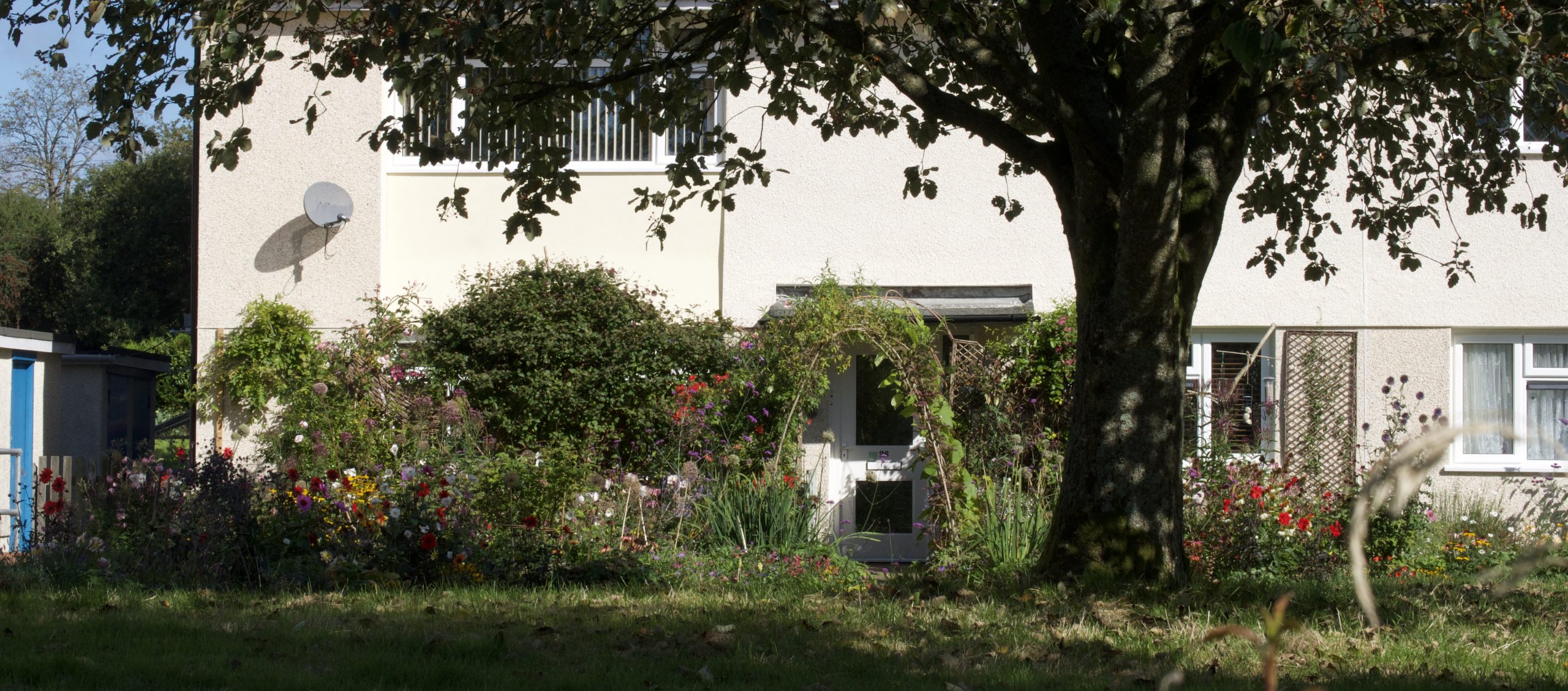
The slow creation and making of the garden around my flat has helped to transform my life in many ways and to add quality to it. It started it as a way to keep busy and to move myself out of the past and feel more comfortable and rooted in the present. As plants, insects and birds change and grow with the seasons this helps to make a future to look forward to entering.
The garden acts as a blanket when I am outside in it. I can blend in and hide and become semi-visible to passers-by who are looking at the flowers and plants, and I just seem to merge into a kind of ornament or weird sculpture. The garden, the plants, the birds, bees, butterflies, moths, worms and all the other wildlife goes on all around regardless of my presence and does not pass any form of judgement on me.

Looking from the inside out into the garden it gives me a sense of security beyond what the physical walls of the building provide. It helps to keep my thoughts in a positive place, not in some dark and dingy hole where they become hard to shift. The garden is an act of defiance to paralysis and provides a protective cushion both physically and to state of mind. It has helped to shift the serpentine shadow of stigma that living in a council property can bring.
The garden is an antidote and a counter narrative to the stigma, an organic way of saying ‘fuck off’ to it, a way of giving a ‘V’ sign with a couple of giant alliums, a stick of rhubarb and a courgette or two.
